Plating process
From bare steelto a corrosion-resistant finish
Every bar moves through the tanks on its program, carried by automatic hoists, in four main stages — pre-treatment, plating, passivation and drying. Plating and passivation tanks are dosed automatically.
Plating and passivation tanksdosed automatically
Chemistry is dosed into the tanks automatically, holding concentration within range continuously between our chemists’ four-hourly analyses — so the coating stays consistent throughout production.
- Auto-dose: plating tanks
- Auto-dose: passivation tanks
- Verified by analysis every 4 hours
- Results logged in the ERP
QC process chart
34 steps from receiving to delivery
Our zinc-nickel (blue) QC process chart. ◇A marks the inspection points on the original chart.
- 01
Receive & set up
- 1Receiving
- 2Racking
- 3Program set-up
- 4Loading
- 02
Surface preparation
- 5Pre-soak clean
- 6Soak clean
- 7Water rinse 1
- 8Water rinse 2
- 9Pre-acid dip
- 10Acid dip
- 11Water rinse 3
- 12Water rinse 4
- 13Electro-cleaning
- 14Water rinse 5
- 15Water rinse 6
- 16Activation
- 17Water rinse 7
- 18Water rinse 8
- 03
Plating
- 19Zn-Ni plating◇A
- 20Water rinse 9
- 21Water rinse 10
- 04
Passivate, seal & dry
- 22Blue passivation
- 23Water rinse 11
- 24Water rinse 12
- 25Sealer
- 26Air blow
- 27Oven
- 28Unload
- 05
Inspection
- 29QC check
- 30Packing
- 31QA check◇A
- 32Functional test
- 06
Store & deliver
- 33Storage
- 34Transport
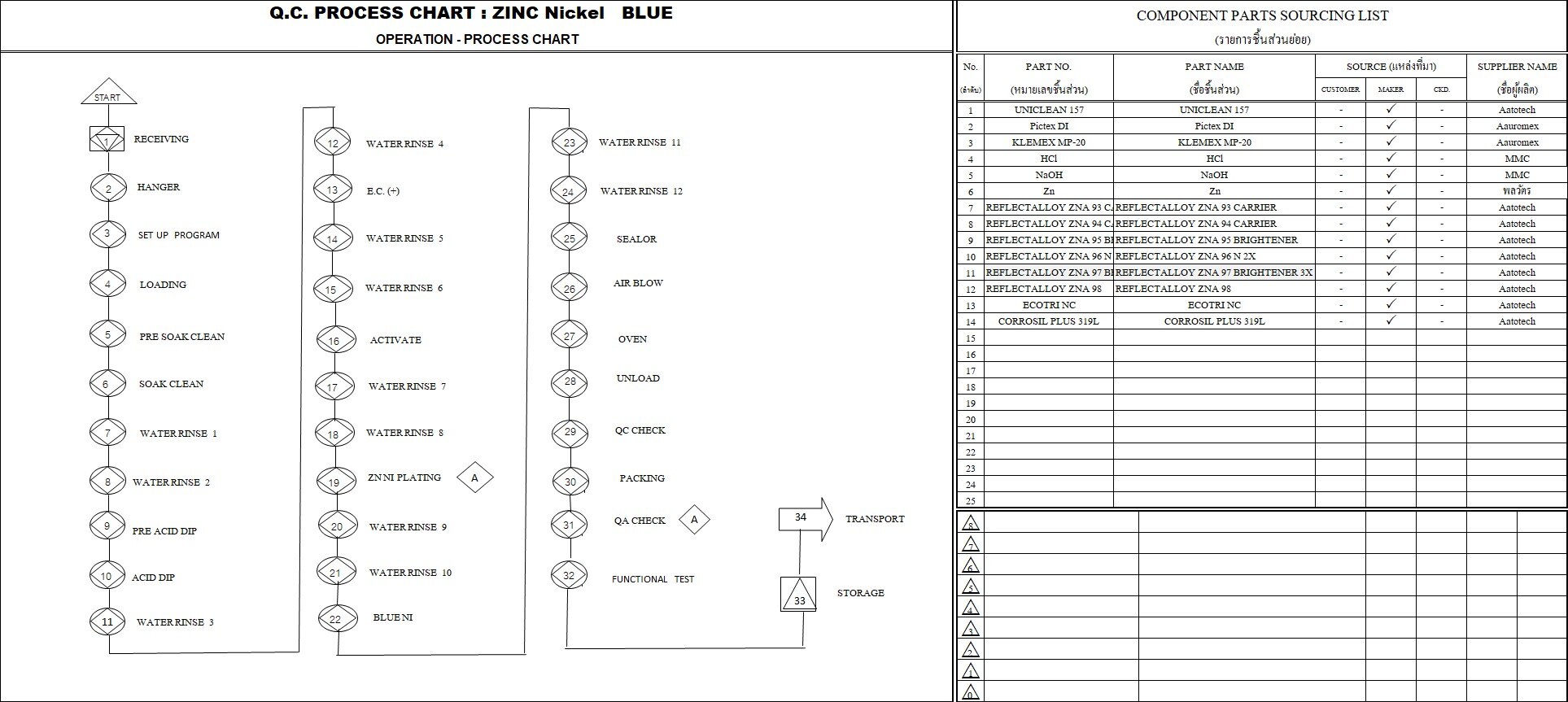
The original chart
Q.C. Process Chart: Zinc Nickel Blue, with the chemical sourcing list — click to view full size.
A coating only bonds to truly clean steel
Pre-treatment
Pre-treatment strips forming oil, rust and scale from the steel, then activates the surface for plating — with water rinses between tanks so no chemistry carries over.
Degreasing
Two alkaline soak-clean tanks dissolve forming oil and grease.
Pickling
Hydrochloric acid removes rust and scale from the steel.
Electro-cleaning
Current releases gas at the surface that scrubs off remaining soil.
Activation
A dilute acid dip removes the thin oxide film just before plating.
Steps on the QC chart
- 5Pre-soak clean
- 6Soak clean
- 7Water rinse 1
- 8Water rinse 2
- 9Pre-acid dip
- 10Acid dip
- 11Water rinse 3
- 12Water rinse 4
- 13Electro-cleaning
- 14Water rinse 5
- 15Water rinse 6
- 16Activation
- 17Water rinse 7
- 18Water rinse 8
How we control it
- Every cleaning and acid tank analysed every four hours
- Each part's program sets its time in every tank
- The PLC logs each bar's time in every tank
- Eight water rinses between the pre-treatment tanks
The heart of the process
Plating Auto-dose
The part is the cathode: current carries zinc — or zinc and nickel — onto the steel until the specified thickness is reached. Thickness depends on current and time in the tank, both set in each part's program.
Non-cyanide alkaline zinc
Even coverage on complex shapes, typically 5–15 µm to spec.
Alkaline zinc-nickel
A high-corrosion-resistance alloy for automotive parts; nickel content checked by XRF.
Steps on the QC chart
- 19Zn-Ni plating
- 20Water rinse 9
- 21Water rinse 10
How we control it
- Auto-dose: chemistry dosed into the plating tanks automatically to hold concentration steady
- Zinc and caustic (NaOH) in the plating baths analysed every four hours
- The PLC logs plating current in each tank, for every bar
- Five-point thickness check on every lot before delivery
Protection and colour
Passivation Auto-dose
After plating, parts are dipped in trivalent (Cr³⁺) passivation, which forms a thin film on the zinc that adds corrosion resistance and gives the specified colour. A sealer goes on top, then an air blow removes the water.
Trivalent passivation
Blue/silver, iridescent or black to the customer's spec — no hexavalent chromium.
Sealer
A top coat over the passivation for extra durability.
Air blow
Blows water off surfaces and out of recesses before the oven.
Steps on the QC chart
- 22Blue passivation
- 23Water rinse 11
- 24Water rinse 12
- 25Sealer
- 26Air blow
How we control it
- Auto-dose: the passivation tanks are dosed automatically
- Passivation pH checked every four hours
- The PLC logs passivation and sealer times for every bar
Fully dry, no water marks
Drying oven
Parts go through the oven to drive off moisture and fully dry the passivation film and sealer, leaving no water marks. They are then unloaded from the hangers and sent to inspection.
Oven
Temperature and time follow each part's program.
Data pending
Unload
Parts come off the hangers into boxes or trays for QC.
Steps on the QC chart
- 27Oven
- 28Unload
How we control it
- The PLC logs top and bottom oven temperature for every bar
- QC inspection right after unloading
What happens next
Every lot is inspected before delivery
QC check, packing, QA with five-point thickness measurement and a functional test — then storage and delivery.
Start your plating project